
150 years of The Western Baths Club

The Western Baths Club in Glasgow is celebrating its 150th anniversary in 2026. To mark the occasion we’ve taken the opportunity to chat to Hilary Barclay, a committee member and long-standing member. Enjoy a fascinating insight into the history, evolution and role of the Baths today.
Can you tell us about the history of The Western Baths Club – who were the founders, how did it come about, what was the vision?
The Western Baths Club came into being, in name anyway, in 1876, when planning permission was granted and construction began shortly thereafter. However, in Glasgow, when people referred simply to “the Baths” they meant the Western Baths – a distinction that has continued through the years.
It was one of five private baths clubs built in the city during this period, with funding raised by the creation of a limited liability company. There were seven original subscribers and six nominated directors, all illustrious gentlemen including merchants, an engineer, a physician and an actuary. The share capital was £10,000 divided into 2,000 shares of £5 each.
The loss of the river Clyde as a viable swimming location, combined with growing concerns about hygiene and public health, led to the construction of both private and public bathing facilities. River swimming, particularly near Glasgow Green, had been hugely popular, for men and boys at least, up until the last quarter of the nineteenth century, after which the once peaceful river became an industrial artery and having a ‘dook’ eventually became impossible. This led to the building of not only the five private pools, but also six public pools between 1870 and 1885. Of the five private establishments only The Western Baths Club and Arlington Baths Club have survived.

How was the design for Western Baths conceived and who was responsible for overseeing this?
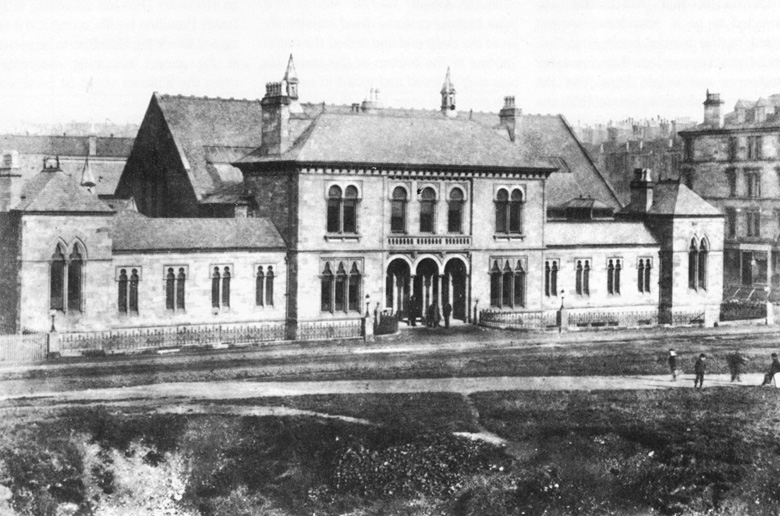
The Western Baths was designed and built by the local firm of Clarke and Bell, Architects and Builders for, legend has it, the sum of £9,000. Although this may have been the estimate, rather than the final figure, which was probably more like £13,000. The firm also designed Glasgow’s City and County Buildings and its renaissance style Fishmarket.
William Clarke and James Bell were highly regarded architects and both lived in Hillhead, the home of the Baths. Given their reputation and local connection, it was natural that they would be awarded the contract. Like other examples of their work, the Baths is a listed building. In this case, A Listed.
The style of architecture could be described as either Spanish Gothic or Moorish. In any case, it was a style which would have been associated with Turkish baths.
It could also be said that the building has the air of a Venetian Palazzo. The first architectural feature upon entering is a grand imperial double staircase and columned entrance hall. There is an arcaded round-arched hall screen and lancet windows overlooking the pool. The pool itself has highly decorative cast-iron roof brackets with ‘W’ and ‘B’ detailed in the roundel. It is also famous for its early pool apparatus, with much loved and well used hanging rings and trapeze.

What facilities did the Baths feature when it opened and how did these evolve?
When it was built in 1876 Western Baths had some of the best facilities in the city, including the largest pool in Scotland at 90ft by 35ft, which was not exceeded until the 1930s.
Structurally, the original building hasn’t been altered much over the last 150 years, although things have been moved around to accommodate changing times. Most of the spaces remain recognisable from old photographs. The most modern addition is the W.M. Mann Building which houses the sports hall and gym with associated changing areas.
In the early 1900s the Baths introduced a new therapeutic section with treatments, some of them sounding rather unnerving, including an Aix Douche, Vichy Massage Douche, Plombieres, Oxygen, Brine and Sulphur Baths and a Liver Pack with Needle Bath. Members could even enjoy a Rectal Douche for two shillings! These facilities started off well but were not financially viable and were abandoned.

Today the Baths is open to all, but that wasn’t always the case. Can you please tell us more?
The Baths in its early days was a very strictly segregated ‘gentleman’s club’ and women had to fight long and hard for equality. Over a period of fifteen years during the ‘20s and ‘30s they continually petitioned the (all male) committee for equal rights and eventually their persistence was rewarded. The committee, it has to be said, nevertheless took every opportunity to scale back female use of the Baths. Today, men and women share equal use of the Turkish and Russian Bath Suite and there are also mixed areas including a poolside sauna and shower area and the reading room in the Sauna Suite.
How does the Baths’ model as a private members club work in today’s world?
The Western Baths remains a jewel in Glasgow’s West End, and members come from the sporting fraternity, the business community, the health care sector and from the hospitality, construction and education sectors. The Baths also supports sporting excellence, particularly among younger members. The Sporting Achievement Board, for instance, now features member Sean Lazzerini who won gold in boxing at the most recent Commonwealth Games.
Facilities today include a sports injury clinic offering massage and physiotherapy, as well as a hairdressing salon. The Deepend Bar & Bistro provides food, drink, themed nights and live entertainment, and is also available for private events.
But its main attraction is a very special atmosphere of friendliness and inclusivity for all ages, abilities and interests. As well as the pool, there are classes in yoga, Pilates and Zumba, circuits, boxercise, aerobics, badminton, spin, Balletfit and Aquafit. Nearly all classes are free to members and also open to non-members.
It may not be a trailblazer, but it does move with the times.
How has The Western Baths Club ensured its survival and who are the individuals who have contributed to this?
In the 1870s, Glasgow was a thriving industrial city with a population of over half a million. The new sunrise industry, following cotton and, before that, tobacco, was shipping. But, despite Glasgow’s prosperity, and in the wake of the crash of the City of Glasgow Bank in 1878, continuing financial problems led to a liquidator being appointed. Less than six years after opening its doors, the Western Baths Club had closed and the four hundred shareholders had lost every penny of the £10,000 they had subscribed. But the symbol of the Western Baths isn’t the Phoenix for nothing and in 1886 the new Western Baths Company was incorporated and a new chapter began.
Then there was the day the roof fell in – literally. On 31 July 1977 a section of the pool hall roof collapsed. The cost of replacing it was in the region of £55,000 and, with a total projected income for the year of only £40,000, all appeared lost. Enter Mr W.M. Mann, who had been a member since 1943 and who agreed to act as Secretary, ensuring the Baths was now run as a business. Mixed bathing and a mixed sauna was introduced, visitors encouraged, group memberships sought and publicity courted. Bill Mann turned the fortunes of the Baths around and, in 1979, there was an overall surplus – the first for many years. He remained Secretary until 2014. The phoenix had risen again.
It would be remiss not to mention the Bathsmasters, all of whom played a major role in the life of the Baths. In the early days they lived on the premises, and were expected to have a wife who would carry out her own duties. On a practical level the Bathsmaster ran the Baths. He also gave swimming lessons and kept small boys in check, having the power to suspend miscreants. Robert Campbell was the longest running and served from 1912 to 1946. The last Bathsmaster was Neil Anderson who left in 2011.
How is The Western Baths Club marking its 150th anniversary?
The Baths kicked off its anniversary year with a traditional Ceilidh at the end of February, with tickets selling out within days. The utilitarian sports hall was transformed with drapes and a star cloth and international Ceilidh band Whisky Kiss played. The next event is a Gala Dinner, being held at neighbouring Oran Mor one of the West End’s top venues. The stunning auditorium roof was designed by the late artist and writer Alasdair Gray, a former Baths member who designed the floor of our downstairs foyer. The night is being supported by the W.M. Mann Group -Bill Mann’s son is still a member, as are his grandchildren. There will, of course, be a swimming gala followed by a Hallowe’en Party then a winter Ceilidh to round off the year, plus various children’s events.
Find out more
For the latest updates, news and events check The Western Baths Club website www.thewesternbaths.co.uk and do please follow them if you can on Facebook and Instagram.